Wednesday
12:00 PM
AASP Wednesday Lunch Series with Ariana Kim
Location: Rockefeller Hall, 429
 Department Homepage
The College of Arts & Sciences
Department Homepage
The College of Arts & Sciences

At the time of its founding in 1987, the Asian American Studies Program at Cornell University was the first such program in the Ivy League. Today the program has faculty members in the humanities and social sciences in a variety of departments and colleges. With a minor in Asian American studies, you’ll examine the histories and experiences, identities, social and community formations, politics and contemporary concerns of people of Asian ancestry in the U.S. and other parts of the Americas.
Location: Rockefeller Hall, 429
Location: Rockefeller Hall, 429
Location: Kahin Center
Location: 429 Rockefeller Hall

Environmental photographer James Balog launches the 2026-27 schedule of Cornell's A.D. White Professors-at-Large Sept. 16-17 with a lecture on glacier retreat. The fall series also features visits from artists, scientists and public intellectuals across disciplines with many ties to the College of Arts and Sciences.

Cornell College of Arts and Sciences scholars are among the 42 faculty members and staff from 19 Cornell schools, colleges and units named Engaged Fellows for 2026-2027, the largest cohort since the program’s launch in 2013.

Emily Vo is majoring in computer science and Asian American studies.

Cornell admits the Class of 2030 emphasizing real-world impact, enrolling 5,776 students from 102 countries. At Cornell University, the diverse cohort reflects the land-grant mission and applied learning goals across multiple colleges.
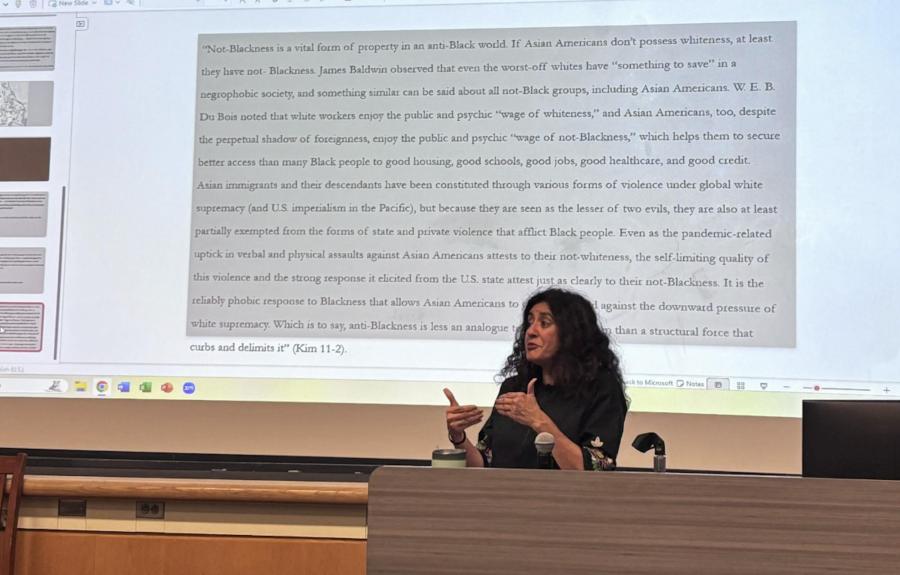
Sandhya Shukla ’88, a professor of English and American Studies at the University of Virginia, presented her ideas of “Cross-Culturalism” on Thursday afternoon in Goldwin Smith Hall.

“Strangers in the Land,” the recently published book by New Yorker Editor Michael Luo, chronicles the journey of Chinese immigrants to the American West, and then eastward across the country. Perhaps inevitably, it is also an account of the violence and bigotry directed against them, which only became more intense as the boom years of…
The Asian American Studies Program gave me the critical tools to re-examine existing structures of inequity and trace the historical roots of pan-ethnic movements in ways I never had before. [The classes] challenged me to think more carefully about identity, representation, and power. Beyond those core courses, I’m also grateful that the program opened doors to broader explorations in Asian studies, from Southeast Asian history to Korean literature. AASP gave me space to ask bigger questions, and I’ll carry that habit of critical thinking long after graduation.
- Vincent Huang '26 (Computer Science)